Our Story - Blog
Sunday Strategies 108


A pizza cutter led to Less Stress for Handwriting Lessons......
When I was a new teacher, I found myself in several schools and with many different skill levels of students. Not only that, but I had teachers that had school bought handwriting curriculums, sped teachers with adaptive curriculums and high schools with no handwriting curriculum. In fact, many of the middle schools had given up handwriting and moved on to typing and dictation. I kept hearing “they don’t even teach handwriting anymore”. But I did! Was I behind the times? Should I move on to just accommodations? I was leaning towards that with my older students until I met a high school teacher that worked on functional life skills: things like signing your name and filling out a job application and making a list. It was like a big “A-Ha!” went off in my head! This is what is needed!
As my love for helping students with functional handwriting began to grow, I found myself being overwhelmed...
Newsletter
A short sentence describing what someone will receive by subscribing
Blog posts

Abundant Resources: Fun Ways to Use LegiLiners for Handwriting, Cutting, Math, and Fine Motor Skills
I’m Polly Benson, your OT handwriting coach, and today we are talking about abundant resources: fun ways to use LegiLiners for handwriting, math, and fine motor skills.
I created LegiLiner because I wanted a quick, simple way to add structured writing support to any paper. Today I want to show you some of the fun things you can do with LegiLiners, not just for handwriting but also for cutting, spacing, math, fine motor skills, visual motor practice, and more.
What Is a LegiLiner?
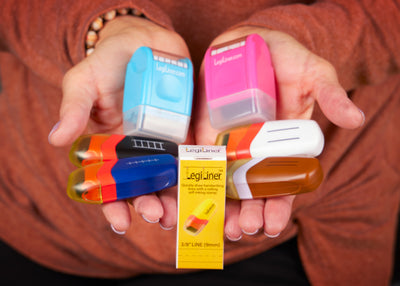
A LegiLiner is a self-inking rolling stamp. You roll it across the paper, and it quickly creates handwriting lines, boxes, number lines, grids, music staff lines, or other structured supports.
Instead of trying to draw straight lines by hand, you can roll out exactly what the student needs in just a few seconds.
That is what makes them so helpful for teachers, therapists, homeschool parents, and anyone working with a child who needs extra visual structure.
Spaces LegiLiner
The Spaces LegiLiner draws a large handwriting line with a broken baseline at the bottom. This is helpful for beginner writers who are learning how to space their letters and words.
The broken baseline gives the student a visual cue for where the letters should sit. It is especially helpful when a student is still learning where to place letters on the line.
Photo idea: Show an example of the Spaces LegiLiner rolled across paper with a child’s writing on the line.

Using LegiLiners for Cutting Practice
One of my favorite ways to use this stamp is for beginning cutting practice.
You can roll out a line and have the student cut along the dashed line in the middle. I like to tell students to keep their thumb on top while they are cutting. That little cue helps them remember the correct hand position.
You can also add stickers to the line. The student can cut to the sticker, stop, and then cut to the next sticker. This gives them a clear target and makes cutting practice more fun.
If a student is learning how to cut a circle, you can place stickers around the outside of the circle and have the student cut through the stickers as they go. It gives them a visual “aim point” instead of just expecting them to follow the curve.
Photo idea: Show a dashed LegiLiner cutting line with stickers placed along the path.

Choosing the Right Size LegiLiner
The main handwriting LegiLiners come in different sizes, and I like to think of them as a progression.
We usually start bigger and then move smaller as the student gains control.
The Spaces LegiLiner is a 1-inch line, which is great for beginner writers.
The red 3/4-inch LegiLiner is perfect for kindergarten or later pre-K students who are ready for something a little smaller.
Then students can move to the 1/2-inch LegiLiner.
The smallest dashed handwriting LegiLiner is the 3/8-inch size. We call this one the “pen” because it looks like a little highlighter pen. This one is about wide-rule size.
I love that the LegiLiners are color-coded. If it is a different color, it is a different line. That makes it easier to grab the right size quickly.

Drawing Curved Lines for More Challenge
Another fun way to increase the challenge is to draw a curved LegiLine.
This can be used for pencil control, letter placement, or cutting practice.
For handwriting, the student can practice starting the pencil at the top line, bringing the letter down, and keeping lowercase letters in the right space. When you put the writing line on a curve, it adds an extra challenge because the student has to follow the curve and still control letter size and placement.
For cutting, you can roll out a curved dashed line and have the student cut along it.
I also love using little cutting helpers, like hungry cutters, cars, or rocket ship magnets on scissors. They help the student know which side should be up. I always remind students, “Thumbs on top,” when they are cutting.

Shaded Baseline LegiLiner
The shaded baseline LegiLiner is one of my favorite supports for students who struggle with letter size.
This stamp has a shaded lower section, which helps students see where the little lowercase letters are supposed to stay.
It is the same 3/4-inch size as the red handwriting LegiLiner, but it adds that shaded area at the bottom.
The shaded baseline is great for students who have trouble paying attention to the line, students with visual challenges, or students who are having a hard time sizing their letters.
It gives them a very clear visual cue for how large or small those lowercase letters should be.
Photo idea: Show lowercase letters sitting inside the shaded baseline area.
Dotted Thirds LegiLiner
The Dotted Thirds LegiLiner separates the writing space into three sections: top, middle, and bottom.
This can be used for printing or cursive.
The bottom dashed line becomes the baseline, and then students can see the top section, middle section, and bottom section. This helps with letters that go tall, letters that stay small, and letters that drop below the line.
This one is especially helpful when students need a more detailed visual guide for letter placement.

Worm Line LegiLiner
The Worm Line LegiLiner is another handwriting-specific stamp.
It has four lines, but instead of having two dashed lines in the center, one of those center lines is solid. It also has an extra baseline, which is what we call the worm line.
This particular stamp works well with the Fundations-style approach and gives students a structured way to understand where letters belong on the writing line.
LegiBoxes
LegiBoxes quickly roll out a line of boxes. These are great if you are familiar with letter boxes or programs like Handwriting Without Tears.
There are so many fun things you can do with LegiBoxes.
One simple way to use them is for copying letters or words. You can write a model word on the top row, and then the student can copy the word underneath.
You can also add starting points in the boxes. That way, the student knows exactly where to begin each letter.
I had a teacher at a homeschool convention in California tell me about a parent who used LegiBoxes for spelling. For example, you could write “cat” or “cot” and have the student focus on changing the middle sound. The boxes give each letter its own space.
LegiBoxes are also great for visual motor patterns. You can shade pink, white, pink, and white for an AB math pattern. You can use them for bar graphs. You can shade four out of five boxes to show a fraction or part of a whole.
Teachers are also using LegiBoxes to draw ten frames. With ten frames, students can quickly see five on top and five on the bottom. If they know each row is five, they can start to visually understand groups of ten, number combinations, and quantities.
You can also use LegiBoxes for sentences. You do not always have to do direct copy. You can roll out a long line of boxes and write a sentence across the top, such as, “My name is Polly.” Then the student can use the boxes to help with spacing and letter placement.
Another fun idea is to turn LegiBoxes vertically for math. You can line up numbers for addition, subtraction, multiplication, or carrying. This helps students keep digits in the correct columns.
LegiBoxes are also great for teaching fractions. If you have eight boxes, eight out of eight is one whole. You can shade four boxes to show one half. You can divide the boxes in different ways to show halves, fourths, or other fraction concepts.
And for fine motor work, students can snip the boxes apart. That gives them a simple cutting activity with a clear target.

Double Line LegiLiner
The Double Line LegiLiner is another great handwriting support.
This is similar to the wide-rule line, but without the dashed middle line. It gives students a simplified writing space.
In programs like Handwriting Without Tears, the double line is often used as the bottom two lines. The top line becomes the midline, and the bottom line becomes the baseline.
This reduces visual distraction for students who get overwhelmed by too many lines. Some students do better when the page is cleaner and simpler.
Older students can also use the Double Line LegiLiner as a wide-rule line. It looks less “babyish” than some of the larger handwriting lines but still gives them the support they need.
You can also turn the double line vertically and use it for math alignment. It helps students line up numbers for addition, subtraction, or multiplication.
Number Line LegiLiner
The Number Line LegiLiner quickly rolls out a straight number line with evenly spaced tick marks.
That is one of the things I love about it. When we draw number lines by hand, the tick marks are never exactly even. The line is not always straight. But with the stamp, the spacing is consistent.
You can use the number line for counting, skip counting, multiplying, dividing, grouping, fractions, and number sense.
For older students, you can even turn it vertically and use it for plotting, graphing, or arrays. It may not be perfectly accurate for every advanced graphing activity, but if you are reteaching the concept or giving a student a quick visual, it is a fun and helpful tool.
I also like using the number line for spacing letters with older students. Sometimes older students still need help with spacing, but they do not want something that looks like early handwriting paper. The number line can give them a visual spacing cue in a way that feels more mature.
You can also use it to teach fractions. For example, you can number ten spaces and talk about how to divide that space into halves, thirds, or other groups. Students can see how the parts fit into the whole.

Adding Lines to Graphic Organizers
One of the best things about LegiLiners is that you can add writing lines anywhere.
You can use them on construction paper, paper plate crafts, paper bags, scrapbook paper, worksheets, or graphic organizers.
This is especially helpful for older students. Sometimes they are given a worksheet with a big empty space, and they are expected to organize their thoughts and write neatly inside it.
That can be hard.
Instead of leaving the space blank, you can quickly roll a few lines inside the box. Now the student knows where to start, where to write, and how much room they have.
For example, if a graphic organizer has a main topic and supporting details, you can roll lines into each section so the student has a place to write. You can use the double line, the thin line, the wide-rule line, or even the music staff if you need very small lines.
This makes the task feel more organized and gives the student a better chance of fitting their writing into the space.

Music Staff LegiLiner
The light blue LegiLiner is the music staff.
Of course, this is great for music teachers and students learning music notation.
But it can also be used in other creative ways. If you need several small lines in a graphic organizer or a small writing space, the music staff gives you five quick lines at once.
Small Squares LegiLiner
The Small Squares LegiLiner is one of my absolute favorite stamps because there are so many things you can do with it.
You can use it for game boards, fractions, bar graphs, ones/tens/hundreds columns, visual perception patterns, reward charts, data collection, and spacing letters.
You can also use it with little flip stamps. If you have used flip crayons before, this is a similar fine-motor idea. The student can stamp and flip, stamp and flip, or stamp, stamp, flip. That builds hand skills while also making the activity fun.
Small squares are also great for reward charts. The student can stamp one square at a time or fill in boxes as they complete tasks.
For math, you can shade boxes to show fractions or use the squares for bar graphing. You can turn the stamp vertically for measurement activities, similar to the marks on a beaker.
For fine motor work, you can put a bead in each square. You can also use a hole punch and have the student punch a hole in each square. Every time they punch, they are working on grip strength.
And yes, you can use small squares for handwriting too. You can have students write one letter in each box to work on spacing. You can also use the box as a visual cue for lowercase letter size, almost like a shaded area.

Cube LegiLiner
The last stamp is the Cube LegiLiner. This stamp is six stamps in one, with each side being a rolling stamp.
The first side is a handwriting line, and the cube gives you several different options in one tool. The second side is a dotted-thirds handwriting line, which is especially helpful for print or cursive. The third side is a number line. The fourth side is a letter box with a dashed line to practice individual letters in print or cursive. The fifth and 6th sides are for practicing fractions of 4 or 8, but they are also great for practicing letter formations. The pie chart size is consistent, repeats, and allows for tracing round or diagonal letters. The four-square box is also good for straight letters and learning letter case placement, like how a capital P stands in the box and a lowercase p hangs in the lower box.

Why I Love Using LegiLiners
The reason LegiLiners are so helpful is because they make it easy to add structure exactly where the student needs it.
Could we draw straight lines by hand? Yes.
But the spacing would vary. The lines might not be straight. The tick marks on a number line would not be even. The boxes would not be consistent.
LegiLiners make it fast and simple.
They give students clear visual boundaries without making the task more complicated for the adult. You can use them for handwriting, cutting, math, spacing, fine motor work, visual motor patterns, crafts, worksheets, and graphic organizers.
That is why I call this day “abundant resources.”
Sometimes the support a student needs is not a whole new curriculum or a complicated strategy. Sometimes they just need the right visual cue, in the right place, at the right time.
And that is exactly what LegiLiners were created to do.

Resources That Make Handwriting Fun and Easy
Resources. I have a lot of interesting things to discuss with you today, so I need to get over the legiLiners. Dollar Tree OT is one of the things I frequently teach. You can purchase occupational therapy supplies at the dollar store. This is merely a list. You can use it as a resource items that you can use for OT fine motor exercises. Stickers, dry erase boards, clothes pins, Play-Doh, shoelaces, beads, push pins, paper clips, tweezers, hole punchers, straws, pom poms, golf t-shirts, hair elastics, shaving cream, bubble wrap, Q-tips, playing cards, disposable cups for sorting and stacking, tongs, chopsticks, lint remover, rollers, index cards, rubber bands, and ice cube trays. I adore ice cube trays.
Ideas include Velcro, balloons, blow toys, bubbles, and many others. This list is four pages long. The dollar store offers sixty different items for fine motor exercises. It's not just the list, either. Activities include things like shoelaces. You can practice tying shoes. You can practice weaving the shoelaces through a hole-punched card and adding beads to the shoelaces. After punching holes in a card, you can begin sewing. Another option is to use pool noodles and wrap them in rubber bands. You can cut the pool noodle and attach it to a string or rope. You can push golf tees into it. The golf tee can be used to balance a tiny puffball that has been forced into the pool noodle slice. Just many different ideas like that. Practice dressing, shaving cream, socks, and dry erase. It's a fun resource. OT suggestions for a fine motor kit. I wholeheartedly endorse the creation of a fine motor kit.
The top ten things you should have in your fine motor kit include a clothespin or tweezer of some sort, scissors, putty or Play-Doh, shoelaces, beads, dice, mini tops, cards, fidgets, and Wikisticks. I included a couple extras. Stickers, hole puncher, tennis ball buddy, and push pins.
This is another source of fun fine motor exercises and things you should have in your kit. Place everything in a pencil box, shoe box, or similar container. Additionally, before sitting down to practice handwriting, your students can complete a fine motor exercise as part of the handwriting warm-ups.
Please view the following video for more details: YouTube: https://www.youtube.com/watch?v=P3iUnCNJ5W8

Dollar Tree OT: Fine Motor Resources and Activities
I have a bunch of fun things to share with you today. One of the things that I often teach is “Dollar Tree OT." This is a workshop on occupational therapy tools you can get at the dollar store. I have a list, and it is a resource for you.
These are things you can use for OT from the Dollar Tree for fine motor activities: clothespins, stickers, dry erase boards, Play-Doh, shoelaces, beads, pushpins, paper clips, tweezers, a hole puncher, straws, pom-poms, golf tees, hair elastics, shaving cream, bubble wrap, Q-tips, playing cards, disposable cups for stacking and unstacking, sorting tongs, chopsticks, lint remover rollers, index cards, rubber bands, and ice cube trays. I love ice cube trays. They are great for sorting and keeping small items from rolling away.
There are also bubbles and blow toys, Velcro, balloons, and lots of different ideas. I have over four pages here with 60 different things you can get at the dollar store to do fine motor activities.
And it’s not just the list. There are activities included, too. For example, it might say “shoelaces.” With shoelaces, you can work on shoe tying. You can work on putting beads on the shoelaces, and then you can also weave the shoelaces through a hole-punched card. You take a card, hole punch it, and then you can do sewing.
You can also use pool noodles. You can put rubber bands around the pool noodles. The pool noodle can be sliced and strung onto a rope or string. Golf tees can be pushed into it. A small puffball that has been pushed into the pool noodle slice can be balanced on the golf tee.
There are just a lot of various concepts like that. You can use socks, shaving cream, practice dressing skills, or dry-erase activities with the socks. It’s an entertaining resource.
OT Ideas for a Fine Motor Kit
Making a fine motor kit is something I strongly support. Your students can perform handwriting warm-ups by doing a fine-motor exercise before sitting down to practice the actual handwriting.
A clothespin or tweezer of some kind, scissors, putty or Play-Doh, shoelaces, beads, dice, mini tops, cards, fidgets, and WikkiStix are among the top ten items you should have in your fine motor kit. I added a few extra ideas, including pushpins, stickers, a tennis ball buddy, and a hole puncher.
Put all those items in a shoebox, pencil box, or similar container. Don’t forget your LegiLiners!
For additional information, please watch the following video: https:https://www.youtube.com/watch?v=P3iUnCNJ5W8

Critical Causes of Messy Writing That Teachers Often Miss
Causes of messy writing include fine motor skills and visual motor integration, which is the process of vision combining with motor skills. When lighting is low or vision is impaired, the ability to perform a motor skill decreases.
For example, if I am writing a note in a dark room, I must look closely and use glasses to ensure my pencil is placed correctly and letters do not overlap. These factors similarly affect children when their vision and motor skills do not combine properly.
A student may have a cognitive deficit, developmental delay, brain injury, or simply be too young. We should investigate why poor motor or thinking skills are contributing to poor handwriting. They may also have learning disabilities or physical conditions.
The writing environment, such as poor lighting or stress and fatigue, also plays a role. In the video, the boy was leaning over and yawning because he was tired from after-school sports, and his parents faced time and financial constraints regarding therapy.
All of these factors contribute to messy writing.
For additional information, please watch the following video: https://youtu.be/7HZ6TzpQF-E